
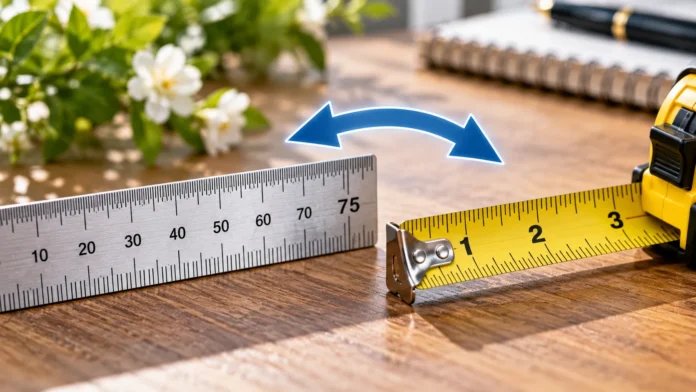
Converting measurements between millimeters and inches is a common requirement in everyday life, especially when working with tools, furniture, construction materials, and technical equipment. If you are wondering how much 75 mm is in inches, the answer is approximately 2.95 inches. Understanding this conversion makes it easier to compare dimensions across different measurement systems and choose the correct sizes for your projects.
The metric system uses millimeters to measure smaller lengths, while the imperial system commonly uses inches. Because different countries and industries follow different measurement standards, converting between these units is often necessary. Knowing how to calculate millimeters to inches helps you interpret product specifications, read technical drawings, and avoid mistakes when comparing measurements from international manufacturers.
Fortunately, converting 75 millimeters to inches requires only one simple mathematical formula. Whether you need an exact value, a rounded measurement, or an approximate fractional inch equivalent, the process is straightforward. This guide explains the conversion formula, provides practical examples, and explores common situations where converting 75 mm into inches can be useful.
How Much Is 75 mm in Inches?
The exact conversion of 75 mm to inches is approximately 2.9527559055 inches. For most everyday applications, this value can be rounded to 2.95 inches without creating a meaningful difference. However, projects requiring precise measurements may benefit from using additional decimal places rather than relying on a simplified conversion.
Millimeters and inches are both units of length, but they belong to different measurement systems. Millimeters are part of the International System of Units, while inches are widely used within the United States customary and British imperial measurement systems. Understanding their relationship makes it easier to convert measurements accurately without depending entirely on online calculators.
When comparing 75 mm with common inch measurements, it is slightly smaller than 3 inches. Three inches equals exactly 76.2 millimeters, meaning 75 mm is 1.2 millimeters shorter. This comparison offers a useful reference when estimating dimensions for household objects, tools, or materials measured in either system.
What Is the Formula to Convert 75 mm to Inches?
The standard formula for converting millimeters into inches is straightforward because one inch equals exactly 25.4 millimeters. To calculate inches, divide the measurement in millimeters by 25.4. This relationship is internationally standardized, making it reliable for engineering, manufacturing, construction, and everyday measurement conversions.
The formula is written as Inches = Millimeters ÷ 25.4. When converting 75 millimeters, substitute 75 into the formula and divide it by 25.4. The result is approximately 2.9527559055 inches, which can be rounded based on the level of precision required for your particular task.
This formula works for any positive measurement expressed in millimeters, not just 75 mm. For example, converting 100 mm requires dividing 100 by 25.4, producing approximately 3.937 inches. Once you understand this calculation, you can convert almost any millimeter measurement into inches using a calculator or basic arithmetic.
Step-by-Step Guide to Converting 75 mm to Inches
The first step in converting 75 mm to inches is identifying the correct conversion factor. Since one inch contains exactly 25.4 millimeters, this number becomes the divisor in the calculation. Using the standardized conversion factor ensures your result matches measurements used in technical documentation and international product specifications.
Next, divide 75 by 25.4 using a calculator or a manual calculation. The mathematical operation produces 2.952755905511811 inches, a decimal value slightly below three inches. Depending on your needs, you can retain the full decimal result or round it to a practical number of decimal places.
Finally, decide how accurately the converted measurement needs to be expressed. For general measurements, 2.95 inches is usually sufficient, while technical applications may require 2.953 inches or greater precision. Always consider the accuracy of the original measurement because displaying extra decimal places does not automatically make a physical measurement more accurate.
Why Is 25.4 Used for Millimeter-to-Inch Conversion?
The number 25.4 is used because the international inch is defined as exactly 25.4 millimeters. This standardized relationship provides a consistent connection between metric and inch-based measurements. It allows manufacturers, engineers, scientists, and everyday users to convert dimensions without dealing with different inch definitions across modern measurement systems.
Before international standardization, historical measurement practices sometimes used slightly different definitions of the inch. Modern standardization established a common value that supports accurate international trade and technical communication. Today, the relationship between inches and millimeters is exact, even when decimal conversion results require rounding.
Understanding the conversion factor also helps prevent common calculation errors. Some people mistakenly multiply millimeters by 25.4 when they actually need to divide. Remember that millimeters are smaller than inches, so converting 75 millimeters into inches should produce a smaller numerical value, giving approximately 2.95 inches rather than a larger number.
Is 75 mm Equal to 3 Inches?
Although 75 mm is close to 3 inches, the two measurements are not exactly equal. Three inches measures precisely 76.2 millimeters, while 75 millimeters equals approximately 2.9528 inches. The difference is relatively small, but it can matter when selecting materials or components that require accurate dimensions.
The difference between 75 mm and 3 inches is exactly 1.2 millimeters. In inches, that difference equals approximately 0.04724 inches, which is slightly less than one twentieth of an inch. For casual comparisons, describing 75 mm as nearly 3 inches may be reasonable, but precise applications require the actual measurement.
For example, a component designed for a 75 mm opening may not fit correctly if replaced with a component measuring exactly 3 inches. Even small dimensional differences can affect mechanical connections, tight fittings, or installation tolerances. Therefore, it is better to use the correct conversion rather than assuming these measurements are interchangeable.
75 mm to Inches Conversion Table
A conversion table provides a convenient way to compare 75 mm with nearby measurements without repeatedly performing calculations. It is particularly helpful when working with products available in several metric sizes. By reviewing measurements slightly above and below 75 mm, you can understand how small changes in millimeters affect their equivalent inch values.
| Millimeters (mm) | Inches (in) |
|---|---|
| 50 mm | 1.9685 |
| 55 mm | 2.1654 |
| 60 mm | 2.3622 |
| 65 mm | 2.5591 |
| 70 mm | 2.7559 |
| 75 mm | 2.9528 |
| 80 mm | 3.1496 |
| 85 mm | 3.3465 |
| 90 mm | 3.5433 |
| 95 mm | 3.7402 |
| 100 mm | 3.9370 |
The table shows that 75 mm falls between 70 mm and 80 mm, corresponding to approximately 2.76 and 3.15 inches. These nearby values are useful when comparing tool sizes, hardware dimensions, and construction materials. Every conversion uses the same standardized relationship of 25.4 millimeters per inch.
When using a conversion table, pay attention to how many decimal places are displayed. Rounded measurements are convenient for quick comparisons, but they may not be suitable for precision manufacturing or specialized engineering tasks. If accuracy is especially important, calculate directly from the original millimeter measurement rather than converting from another rounded value.
How to Convert 75 mm to Fractional Inches
Fractional inches are commonly used in woodworking, construction, and some hardware applications, where measurements are expressed as halves, quarters, eighths, or sixteenths of an inch. Since 75 mm equals approximately 2.9528 inches, it does not match a commonly used fractional inch measurement exactly. However, it can be approximated using standard fractions.
To express 75 mm in fractional inches, start with the decimal value of 2.9528 inches. The whole-number portion is 2 inches, while the remaining decimal is approximately 0.9528 inches. Depending on the preferred fractional precision, this remainder can be rounded to the nearest common fraction used in measurement tools.
To the nearest sixteenth of an inch, 75 mm is approximately 2 15/16 inches. To the nearest thirty-second, it is approximately 2 31/32 inches, which provides a closer practical approximation. These fractional values are useful for interpreting measuring tapes, but neither represents the exact metric dimension.
How to Measure 75 mm Using a Ruler
Measuring 75 mm with a metric ruler is simple because millimeters are usually marked as small divisions between centimeter indicators. Since 10 millimeters equal one centimeter, 75 mm corresponds to 7.5 centimeters. Locate the seven-centimeter mark and move an additional five millimeters to identify the required length.
If your ruler displays inches instead of millimeters, use the converted value of approximately 2.95 inches. This measurement falls slightly below the three-inch mark. For a ruler divided into sixteenths, the nearest mark is 2 15/16 inches, although a more precise instrument is preferable when exact dimensions matter.
When taking measurements, place the ruler against a flat surface and align its zero mark carefully with the starting point. Look directly above the scale to reduce reading errors caused by viewing the markings at an angle. For projects requiring greater precision, consider using a digital caliper rather than estimating measurements from a standard ruler.
Common Uses of 75 mm Measurements
Measurements around 75 mm appear in many everyday products, construction materials, and mechanical components. Examples may include hardware fittings, decorative elements, plumbing components, and equipment parts. Knowing the inch equivalent allows users to compare metric specifications with inch-based product descriptions when selecting replacement items or planning installations.
In furniture and interior design, dimensions expressed in millimeters are often used for handles, brackets, fixtures, and smaller accessories. A component listed as 75 mm may need to be compared with inch-based measurements in an installation guide. Converting the dimension to approximately 2.95 inches provides a convenient reference for understanding its general size.
Technical applications may also use measurements near 75 mm when describing components, clearances, or material dimensions. However, the exact meaning depends on whether the measurement represents length, width, diameter, or another feature. Always review the product’s full specifications before making a selection because a single converted dimension does not guarantee compatibility.
Using 75 mm to Inches in Construction Projects
Construction projects frequently involve materials and tools manufactured according to different measurement standards. Imported fixtures may display dimensions in millimeters, while local construction plans use inches. Understanding how to convert 75 mm to inches helps builders and homeowners compare measurements without creating unnecessary confusion during installation or material selection.
For example, a mounting bracket with a listed dimension of 75 mm measures approximately 2.95 inches. This information can help determine whether the bracket fits within an available space. However, installers should also consider hole spacing, thickness, load capacity, and manufacturer tolerances rather than focusing only on the converted dimension.
Accuracy becomes especially important when several components must align correctly. Small rounding differences can accumulate when multiple measurements are added or repeated across a project. Using the original metric dimensions whenever possible, or converting with sufficient decimal precision, helps reduce errors and supports more reliable construction measurements.
Why Accurate Millimeter-to-Inch Conversion Matters
Accurate measurement conversion helps prevent problems when comparing products manufactured using different unit systems. A small mistake may result in purchasing an incorrectly sized component or cutting material to the wrong dimensions. Understanding the correct formula reduces uncertainty and makes technical information easier to interpret across international markets.
Precision is particularly important in manufacturing, engineering, and mechanical assembly, where small differences may affect performance or compatibility. A conversion rounded too early can create errors when dimensions are used repeatedly. Keeping the original measurement available and rounding only at the final stage helps maintain better numerical accuracy throughout a calculation.
For everyday applications, an approximate conversion may be perfectly acceptable. Someone estimating the size of a household object may only need to know that 75 mm is nearly three inches. The important consideration is matching the level of measurement precision to the task rather than using unnecessarily complicated calculations in every situation.
Common Mistakes When Converting 75 mm to Inches
One common mistake is using the wrong mathematical operation during conversion. Because 25.4 millimeters equal one inch, converting millimeters to inches requires division rather than multiplication. Multiplying 75 by 25.4 produces an incorrect value of 1,905, which does not represent the equivalent measurement in inches.
Another frequent mistake involves rounding the answer too aggressively. Although 75 mm is approximately 3 inches, the exact difference can matter when working with precision components. Using 3 inches instead of 2.9528 inches introduces a discrepancy of approximately 1.2 millimeters, which may be significant in some applications.
Confusing centimeters with millimeters can also cause incorrect conversions. Remember that 75 mm equals 7.5 cm, while 75 cm equals 750 mm. Checking the original unit before performing calculations helps prevent errors, especially when reading technical drawings, online product listings, or measurements provided by international suppliers.
How to Convert Inches Back to Millimeters
Converting inches back to millimeters is useful when you need to compare inch-based measurements with metric specifications. Instead of dividing by 25.4, multiply the inch measurement by 25.4. This reverse formula follows the same exact relationship between the two measurement units and works for any measurement expressed in inches.
The formula is Millimeters = Inches × 25.4. For example, multiplying 3 inches by 25.4 produces exactly 76.2 millimeters. If you multiply the rounded value of 2.95 inches by 25.4, the result is 74.93 millimeters, which differs slightly from 75 mm because the original inch measurement was rounded.
To recover the original measurement accurately, retain additional decimal places during intermediate calculations. Using approximately 2.9527559 inches produces a value extremely close to 75 millimeters when multiplied by 25.4. This example demonstrates why rounding should be handled carefully whenever measurements are converted between units more than once.
Can You Convert 75 mm to Inches Without a Calculator?
Converting 75 mm to inches without a calculator is possible using a simple estimation method. Since one inch equals approximately 25 millimeters, dividing 75 by 25 produces an estimated answer of three inches. This method is convenient for quick mental calculations, although it gives a slightly higher result than the actual conversion.
A more accurate mental estimate comes from remembering that three inches equal exactly 76.2 millimeters. Because 75 mm is 1.2 millimeters less than three inches, the equivalent must be slightly below three inches. This observation makes it easy to estimate the answer as approximately 2.95 inches without completing a lengthy division.
For practical situations such as shopping, measuring furniture, or estimating dimensions, this approximation is often sufficient. However, engineering work, detailed woodworking, and precision manufacturing may require a calculator or digital measurement tool. Mental calculations are best used for quick comparisons rather than replacing accurate measurements in projects with strict dimensional requirements.
Benefits of Using an Online mm to Inches Converter
An online millimeter-to-inch converter simplifies measurements by performing calculations automatically. Users only need to enter a value, such as 75 mm, to receive the corresponding measurement in inches. This approach is convenient for people who frequently switch between metric and imperial specifications while comparing products or completing projects.
Many conversion tools also provide additional options, including fractional inches, decimal precision settings, and conversions between several length units. These features can help users compare millimeters with centimeters, feet, or other measurement standards. However, results should still be reviewed to ensure the correct input units and rounding preferences were selected.
Online converters are particularly helpful when handling numerous measurements that would otherwise require repeated manual calculations. They can save time during planning, purchasing, and technical documentation tasks. Even when using digital tools, understanding the basic formula remains valuable because it allows you to verify results and recognize possible input or calculation mistakes.
Conclusion
Converting 75 mm to inches is straightforward once you understand the relationship between millimeters and inches. The exact formula requires dividing 75 by 25.4, producing approximately 2.9527559 inches. For most everyday measurements, rounding this result to 2.95 inches provides a convenient and understandable equivalent.
Knowing how to perform this conversion can be helpful in construction, woodworking, manufacturing, furniture selection, and general household measurements. It also makes comparing products from different countries easier because specifications may use different measurement systems. Understanding decimal values and fractional approximations allows you to select the most appropriate format for your needs.
Whether you use a calculator, conversion table, ruler, or mental estimation, accuracy should remain the main consideration. Remember that 75 mm is slightly smaller than three inches and that rounding differences can affect precise applications. By using the correct formula and choosing appropriate precision, you can convert measurements confidently and avoid common mistakes.
Frequently Asked Questions
How many inches is 75 mm exactly?
75 millimeters equals approximately 2.9527559055 inches. For most everyday measurements, the value is rounded to 2.95 inches, but additional decimal places may be useful for technical applications.
Is 75 mm the same as 3 inches?
No, 75 mm is slightly smaller than 3 inches. Three inches equals exactly 76.2 mm, meaning there is a difference of 1.2 mm between the two measurements.
What is 75 mm in fractional inches?
75 mm is approximately 2 15/16 inches when rounded to the nearest sixteenth. A closer approximation is 2 31/32 inches to the nearest thirty-second, although neither fraction is exact.
How do I convert 75 mm to inches manually?
Divide 75 by 25.4 because one inch equals exactly 25.4 millimeters. The calculation gives approximately 2.9528 inches, which can be rounded according to your measurement requirements.
How many centimeters is 75 mm?
75 millimeters equals exactly 7.5 centimeters because one centimeter contains 10 millimeters. To convert millimeters into centimeters, simply divide the original measurement by 10.